Technical Guide to Bitumen Grade Selection
What Is VG Bitumen? VG10, VG20, VG30 and VG40 Grades, Applications and Selection Guide
VG Bitumen, or Viscosity Grade Bitumen, is a widely used asphalt-binder classification system based on the material’s resistance to flow at specified laboratory temperatures. This guide explains VG10, VG20, VG30 and VG40, their relative characteristics and typical applications, the differences between VG, penetration-grade and PG Bitumen, important quality-control tests, price factors, and the information buyers should provide before ordering.
Quick Answer
VG Bitumen stands for Viscosity Grade Bitumen. It is classified according to viscosity, which indicates the binder’s resistance to flow under defined test conditions. As the VG number increases, the binder is generally more viscous and relatively harder at the test temperature. VG10 is one of the softer grades, while VG40 is relatively harder. Final selection must still consider climate, pavement temperature, traffic, loading, asphalt-mix design and project specifications.
| Topic |
Summary |
| Full name |
Viscosity Grade Bitumen |
| Common grades |
VG10, VG20, VG30 and VG40 |
| Classification basis |
Absolute and kinematic viscosity at specified test temperatures |
| Main applications |
Hot mix asphalt, roads, highways, intersections and heavy-traffic pavements |
| Selection basis |
Climate, pavement temperature, traffic, axle load, asphalt-mix design and project specification |
What Is VG Bitumen?
VG Bitumen is an asphalt-binder grading system that classifies bitumen according to its viscosity at specified laboratory temperatures. Viscosity describes how strongly a material resists flowing. Under the same test conditions, a binder with higher viscosity flows less easily than one with lower viscosity.
In penetration grading, products such as Bitumen 60/70 and Bitumen 40/60 are classified mainly through the depth of penetration of a standard needle under defined conditions. The VG system focuses more directly on the binder’s flow behavior.
Viscosity information is useful when evaluating pumping, transfer through pipelines, mixing with aggregates, asphalt production, spreading and compaction. For this reason, viscosity grades are widely specified in selected paving markets and road-construction standards.
Technical note: The VG number alone is not enough to confirm suitability. Buyers and project engineers should also review the applicable standard, laboratory results, climate, pavement temperature, traffic conditions, asphalt-mix requirements and construction procedure.
What Is the Difference Between VG10, VG20, VG30 and VG40?
VG grades differ mainly in viscosity and relative hardness under the stated test conditions. As the grade number rises, the binder is generally more resistant to flow. However, a higher grade is not automatically better. The correct choice depends on the actual performance and construction requirements of the project.
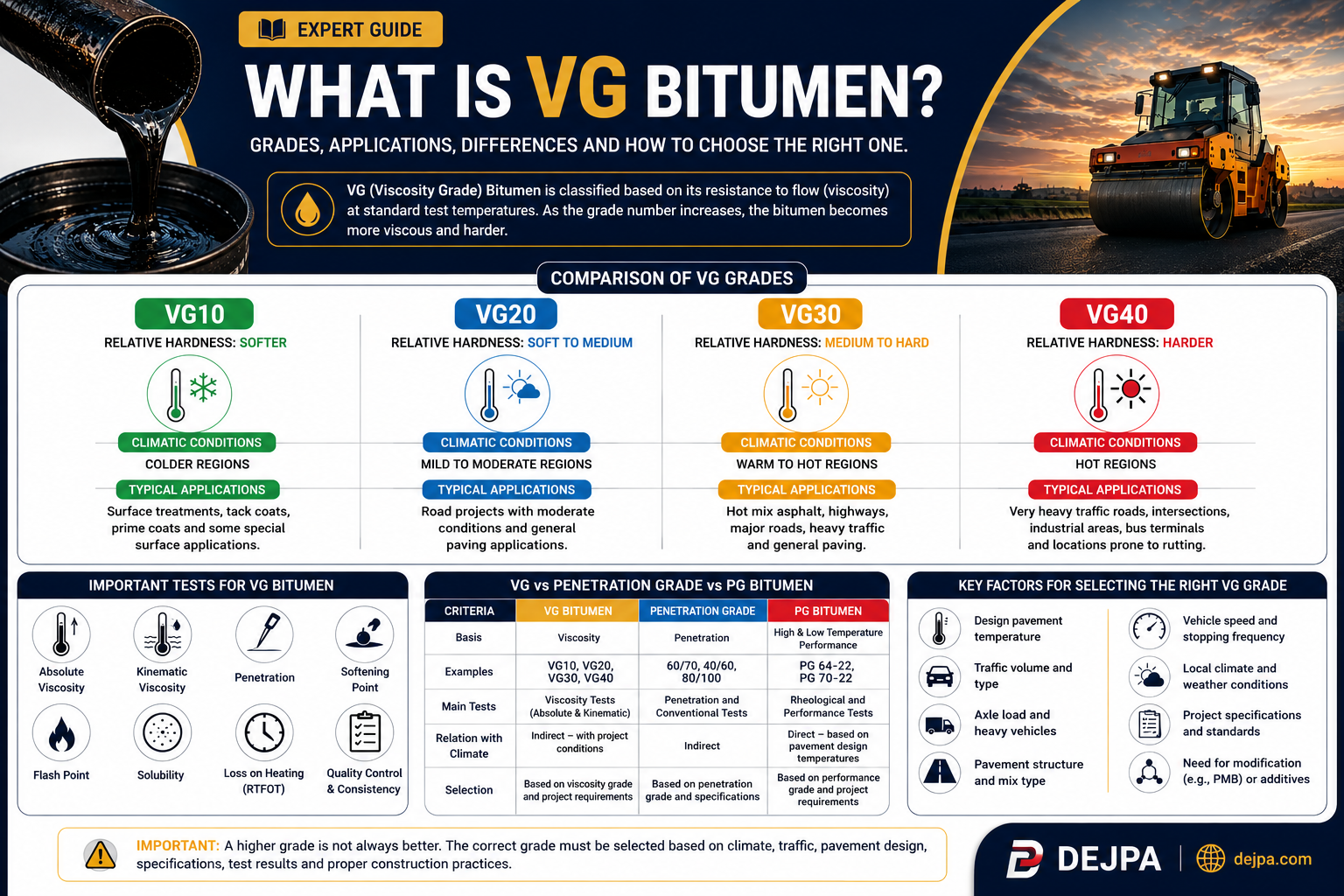
Comparison of VG10, VG20, VG30 and VG40 by relative hardness, climate conditions, typical applications, laboratory tests and grade-selection factors.
| Grade |
Relative Characteristic |
Typical Applications |
Selection Note |
| VG10 |
Softer and less viscous than the higher VG grades |
Colder regions, selected surface treatments, prime coats and special applications |
Suitability depends on climate, standard and construction method |
| VG20 |
Soft to medium relative consistency |
Selected paving projects in mild or moderate conditions |
Must be matched with the project specification and local practice |
| VG30 |
Medium to relatively hard |
Hot mix asphalt, roads, highways and general paving |
Commonly considered for warm climates and regular to heavy traffic |
| VG40 |
Relatively harder and more viscous |
Heavy-traffic routes, intersections, industrial areas and locations prone to rutting |
Cold-temperature behavior and workability must also be reviewed |
Important: The applications listed above are general. Final grade selection should follow the project specification, local climate, pavement structure, asphalt-mix design, traffic loading and laboratory approval.
What Is VG10 Bitumen?
VG10 has lower viscosity than VG20, VG30 and VG40 and is generally regarded as a softer viscosity grade. It may be considered in colder conditions or applications where greater fluidity is required during handling and construction.
Depending on the standard and project requirements, VG10 may be used in selected surface treatments, prime coats, emulsion production or special paving applications. Its exact use should always be confirmed through the relevant technical specification.
What Is VG20 Bitumen?
VG20 is positioned between VG10 and VG30 in terms of viscosity and relative hardness. It may be specified for selected paving projects in moderate climatic conditions or where the design calls for an intermediate viscosity grade.
Demand for VG20 varies by market and project. Before ordering, buyers should confirm the required standard, test limits, packaging, production capability and intended pavement application.
What Is VG30 Bitumen?
VG30 is one of the commonly specified viscosity grades for hot mix asphalt and conventional road construction. It can provide a practical balance between workability during mixing and paving and resistance to deformation under warm pavement conditions.
VG30 may be considered for urban roads, intercity highways, general paving and traffic conditions ranging from normal to heavy, depending on pavement design and local standards. It should not be selected solely because it is widely used; the project specification remains the primary reference.
What Is VG40 Bitumen?
VG40 has higher viscosity than VG30 and is relatively harder under the same classification system. It may be considered for pavements exposed to high temperatures, heavy axle loads, slow-moving traffic, frequent braking or a greater risk of rutting.
Typical project areas may include intersections, bus terminals, industrial routes and heavily loaded pavements. However, using a harder binder without evaluating low-temperature performance and compaction requirements may increase construction difficulty or cracking risk.
VG30 vs VG40: What Is the Difference?
| Criterion |
VG30 |
VG40 |
| Viscosity |
Lower than VG40 |
Higher than VG30 |
| Relative hardness |
Medium to relatively hard |
Relatively harder |
| Typical use |
General hot mix asphalt, roads and highways |
Heavy traffic, warmer conditions and rutting-prone locations |
| Construction control |
Generally easier workability than VG40 |
May require closer control of mixing and compaction temperatures |
VG40 should replace VG30 only when the pavement environment and project specification justify the use of a more viscous binder. Selecting the harder grade without technical justification may increase cost, complicate production or reduce flexibility.
VG Bitumen vs Penetration-Grade Bitumen
The main difference lies in the classification method. Penetration-grade bitumen is classified through needle penetration, while VG Bitumen is classified through resistance to flow at specified temperatures.
| Criterion |
VG Bitumen |
Penetration-Grade Bitumen |
| Classification basis |
Viscosity |
Needle penetration |
| Naming examples |
VG10, VG30 and VG40 |
40/60, 60/70 and 80/100 |
| Relation to construction |
More directly related to flow, pumping, mixing and compaction |
Mainly indicates relative consistency through penetration |
| Selection process |
VG grade plus project and construction requirements |
Penetration grade plus project specification |
Related guides: What Is Bitumen 60/70? and What Is Bitumen 40/60?
VG Bitumen vs PG Bitumen
VG and PG are both more detailed grading approaches than a simple penetration-value comparison, but they use different technical bases. VG classification is based on viscosity, while PG classification focuses on expected binder performance at specified high and low pavement temperatures.
| Criterion |
VG Bitumen |
PG Bitumen |
| Main basis |
Viscosity at specified test temperatures |
Performance at high and low pavement temperatures |
| Naming examples |
VG10, VG30 and VG40 |
PG 64-22 and PG 70-22 |
| Relation to climate |
Indirect and reviewed with project conditions |
More directly linked to pavement design temperatures |
| Main testing approach |
Viscosity and conventional binder tests |
Rheological and performance-related tests |
For a detailed explanation of performance grading, read What Is PG Bitumen?
Common Applications of VG Bitumen
Hot Mix Asphalt
Production of asphalt mixtures for urban roads, highways and conventional pavement projects.
Heavy-Traffic Routes
Higher viscosity grades may be considered where heavy loading and deformation resistance are important.
Intersections and Terminals
Locations exposed to braking, slow-moving traffic, frequent stops and high axle loads.
Surface Applications
Selected softer grades may be used in surface treatments or as feedstock for specific bituminous products.
Important Tests for VG Bitumen
A VG grade should not be accepted only from its product name. Test results must be reviewed against the applicable specification and linked to the correct production batch.
- Absolute viscosity at the specified temperature
- Kinematic viscosity at elevated temperature
- Penetration
- Softening point
- Flash point
- Solubility
- Loss on heating or short-term aging behavior
- Batch consistency and specification compliance
For a broader explanation of conventional binder tests, read What Are the Main Bitumen Quality Control Tests?
How Should the Right VG Grade Be Selected?
Main Selection Factors
- Highest and lowest regional temperatures
- Pavement design temperature
- Traffic volume and traffic type
- Vehicle axle loads
- Vehicle speed and stopping frequency
- Asphalt-mixture type and pavement structure
- Mixing, paving and compaction method
- Applicable standard and employer specification
A harder grade is not always a better grade. Excessive viscosity may reduce workability, complicate compaction or increase cracking risk under unsuitable low-temperature conditions.
Benefits of the VG Classification System
- More direct evaluation of binder flow behavior
- Useful information for pumping, transfer and asphalt production
- Support for mixing and compaction temperature control
- Availability of different grades for different climatic and traffic conditions
- Improved technical communication between buyers, laboratories and producers
- More structured quality control for hot mix asphalt production
VG Bitumen must still be stored and transported correctly. Excessive heating, contaminated tanks, water entry, prolonged high-temperature storage or accidental mixing with another grade may alter viscosity and product uniformity.
Read How Should Bitumen Be Stored and Transported? for more information about temperature control, clean tanks and contamination prevention.
Factors Affecting VG Bitumen Price
VG Bitumen price depends on more than the grade number. Base bitumen, product specification, testing requirements, order quantity, packaging, destination and delivery terms may all affect the final quotation.
VG Grade VG10, VG30 and VG40 may have different production and market conditions.
Base Bitumen Feedstock quality and base-binder properties influence the final product.
Testing and Inspection Additional testing, inspection and documentation may affect the quotation.
Order Quantity Volume affects production planning, loading and commercial terms.
Packaging Bulk, drums and other packaging systems have different cost structures.
Destination and Delivery Delivery point, transport method and destination influence the final price.
For a broader explanation of commercial and technical pricing factors, read the Iran Bitumen Price Guide.
Information Required for Ordering VG Bitumen
| Required Information |
Description |
| Grade |
VG10, VG20, VG30 or VG40 |
| Standard |
Applicable specification and approved test methods |
| Order quantity |
Required volume in metric tons |
| Packaging |
Bulk, drums or another requested packaging format |
| Destination |
Country, port, city or agreed delivery point |
| Technical documents |
COA, laboratory results, inspection certificate or technical datasheet |
The Certificate of Analysis should be compared with the project specification before purchase. Read How to Read a Bitumen Certificate of Analysis for a practical review process.
Quality Control and Sampling
To confirm that the shipment matches the ordered VG grade, the sample must represent the actual tank, tanker, transfer line or batch. Clean containers, correct labeling, sealing, batch identification and retained samples are important for traceable quality control.
Read How Is Bitumen Sampled? for guidance on representative samples, containers, labeling and retained samples.
Important Points Before Buying VG Bitumen
- Identify the exact VG grade from the project specification.
- State the applicable standard in the purchase request.
- Review viscosity and other quality-control results.
- Verify the batch number and production date.
- Confirm packaging, transport and unloading requirements.
- Agree on storage and delivery temperatures.
- Use retained samples or independent inspection for sensitive projects.
Conclusion
VG Bitumen is a viscosity-based asphalt-binder classification system that provides practical information about flow, pumping, mixing, transport and paving behavior. VG10, VG20, VG30 and VG40 differ in viscosity and relative hardness.
VG30 is commonly considered for hot mix asphalt and general road construction, while VG40 may be evaluated for warmer conditions, heavy traffic and locations with greater rutting risk. VG10 and VG20 may be used where a softer or intermediate viscosity grade is technically required.
The correct grade should not be chosen only by selecting the highest number or the lowest price. Climate, pavement temperature, traffic, asphalt-mix design, specification limits, laboratory results and construction conditions must all be reviewed together.
Request VG Bitumen Specifications and Price
To request a technical review or quotation for VG Bitumen, provide the required grade, project standard, order quantity, packaging, destination, delivery terms and requested quality documents. Production or supply availability should be confirmed after technical evaluation.
Contact Dejpa and Submit Your Request
Frequently Asked Questions
What is VG Bitumen?
VG Bitumen is an asphalt-binder grading system based on viscosity, or the material’s resistance to flow at specified test temperatures.
What are the main VG Bitumen grades?
VG10, VG20, VG30 and VG40 are among the commonly recognized viscosity grades.
What is the difference between VG30 and VG40?
VG40 is more viscous and relatively harder than VG30. It may be considered for heavier traffic, warmer conditions or locations with higher rutting risk.
Is VG40 always better than VG30?
No. VG40 is suitable only when the pavement design, climate, traffic and construction requirements justify a more viscous grade.
What is the difference between VG Bitumen and Bitumen 60/70?
VG Bitumen is classified by viscosity, while Bitumen 60/70 is classified by needle penetration.
What is the difference between VG and PG Bitumen?
VG grading is based on viscosity, while PG grading evaluates expected binder performance at specified high and low pavement temperatures.
What information is required for a VG Bitumen quotation?
Buyers should provide the exact VG grade, standard, order quantity, packaging, destination, delivery conditions and required technical documents.
Related Articles