Introducing Dejpa Specialized Bitumen Products
What Is PG Bitumen? Performance Grades, Applications and Selection Guide
PG Bitumen, or Performance Grade Bitumen, is a system for classifying and evaluating asphalt binders according to their expected behavior under different pavement-temperature conditions. This article explains grades such as PG 64-22, the differences between PG Bitumen, penetration-grade bitumen and polymer-modified bitumen, common applications, important laboratory tests, pricing factors, and the information required for selecting and ordering the appropriate product.
Quick Answer
PG Bitumen stands for Performance Grade Bitumen. It classifies asphalt binders according to their expected performance within specified high- and low-temperature ranges. In PG 64-22, 64 represents the high-temperature performance grade and −22 represents the low-temperature performance grade. The correct grade should be selected according to pavement design temperatures, climate, traffic volume and type, loading conditions, pavement structure, and project specifications.
| Topic |
Summary |
| Product type |
Performance-based asphalt binder classification for high- and low-temperature behavior |
| Grade examples |
PG 58-22, PG 64-22, PG 70-22 and project-specific grades |
| Selection basis |
Climate, pavement temperature, traffic, loading and technical project requirements |
| Common applications |
Highways, heavy-traffic routes, airports and performance-specified paving projects |
| Main difference |
Unlike penetration grading, PG classification directly addresses expected temperature-related performance |
What Is PG Bitumen?
PG Bitumen is a performance-based classification system for asphalt binders. It evaluates a binder according to its expected behavior at high and low pavement temperatures. The objective is to avoid selecting bitumen only through a general property such as penetration and to connect binder selection more directly with actual project conditions.
In the penetration grading system, products such as Bitumen 60/70, Bitumen 40/60 and Bitumen 80/100 are classified according to the penetration range measured under standard test conditions. This provides useful information about relative binder consistency, but it does not by itself describe full performance under different pavement temperatures and traffic conditions.
The PG system creates a clearer relationship between binder properties and expected field conditions. Grade selection should therefore consider pavement temperature, traffic loading, vehicle speed, repeated stops, pavement structure, design requirements and the technical specification issued by the employer or consultant.
Technical note: PG temperature numbers should not be interpreted simply as daily air temperatures. They are part of a pavement-design and binder-evaluation system. Final selection must follow the applicable standard, climate data, pavement design and technical approval process.
What Do Grades Such as PG 64-22 Mean?
A PG Bitumen grade normally contains two numbers. The first number is associated with high-temperature performance, while the second number, shown with a minus sign, is associated with low-temperature performance.
First Number: High-Temperature Grade
In PG 64-22, the number 64 refers to the required high-temperature performance grade. This part of the classification is related to resistance against excessive softening, rutting and permanent deformation at elevated pavement temperatures.
Second Number: Low-Temperature Grade
The −22 value refers to the required low-temperature performance grade. It is associated with the binder’s resistance to excessive stiffness and thermal cracking under cold pavement conditions.
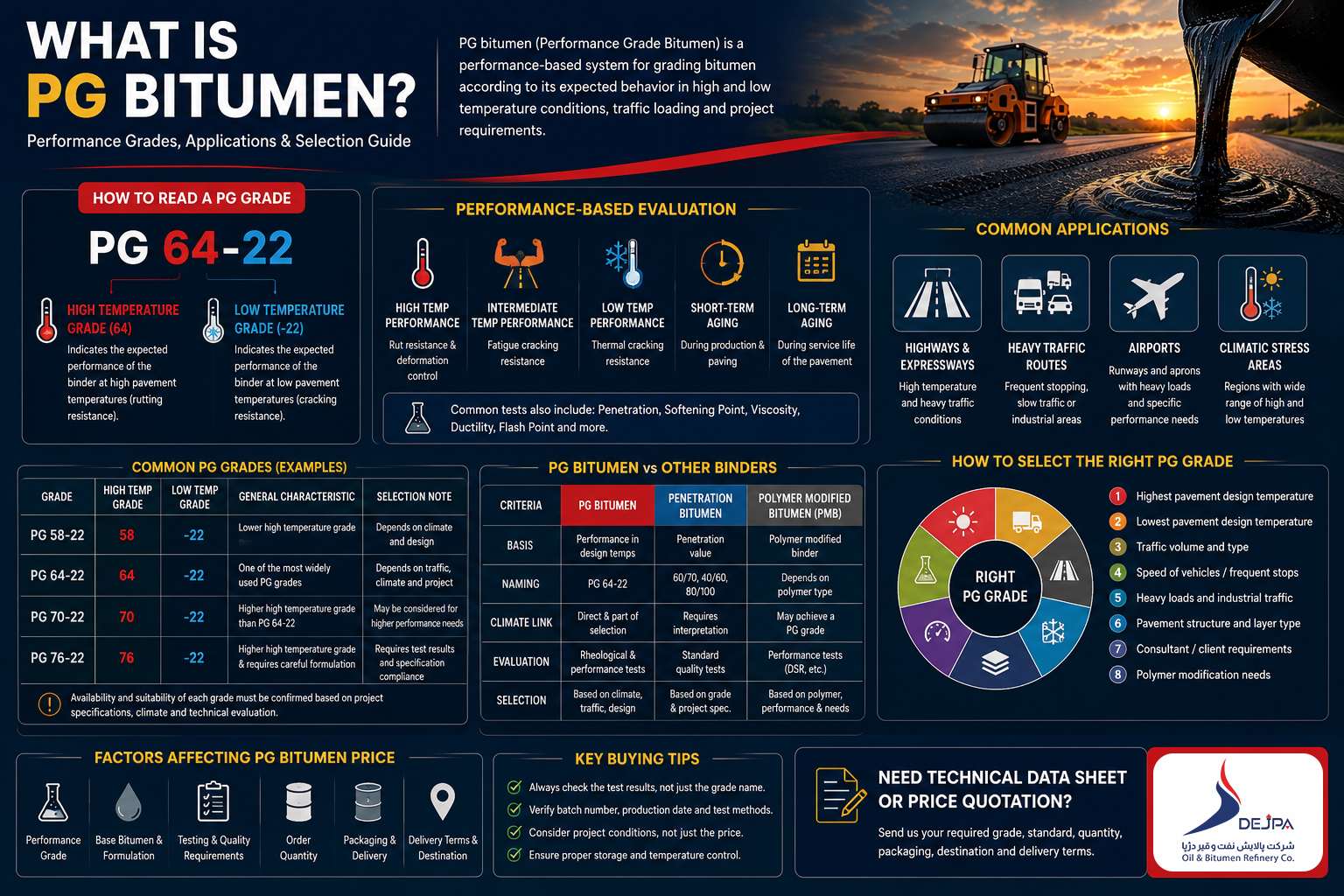
The infographic summarizes PG 64-22 interpretation, performance-based evaluation, common grades, applications, selection factors and key purchasing controls.
Practical Example: PG 64-22
PG 64-22 indicates that the asphalt binder must meet the specified performance requirements for a high-temperature grade of 64 and a low-temperature grade of −22. This designation helps the pavement designer, laboratory and project owner evaluate the binder according to expected field conditions.
However, PG 64-22 is not automatically suitable for every warm or cold region. Actual pavement temperatures, traffic loading, vehicle speed, project location, pavement design and the applicable technical specification must be reviewed before final selection.
Common PG Bitumen Grades
PG grades are available in different combinations of high- and low-temperature performance levels. The following examples are provided only to explain the grading system. Suitability and product availability must be confirmed for each project.
| Grade Example |
General Characteristic |
Selection Note |
| PG 58-22 |
Lower high-temperature grade than PG 64 or PG 70 |
Selection depends on climate and pavement design |
| PG 64-22 |
A widely recognized example of a PG binder grade |
Traffic and pavement temperatures must be reviewed |
| PG 70-22 |
Higher high-temperature grade than PG 64-22 |
May be considered where higher-temperature performance is required |
| PG 76-22 |
Higher high-temperature performance and more demanding formulation requirements |
Test results and project specifications must be carefully reviewed |
Important: The grades above are examples of performance-grade naming. Before ordering, the exact grade, project standard, climate, traffic conditions and production or supply capability must be confirmed.
Common Applications of PG Bitumen
PG Bitumen is commonly considered where binder selection must be linked directly to climate, traffic and expected pavement performance.
Highways and Expressways
Pavements exposed to continuous traffic, repeated loading and elevated pavement temperatures.
Heavy-Traffic Routes
Urban and industrial routes with slow-moving traffic, frequent stops or heavy axle loads.
Airports
Runways, taxiways and aprons exposed to high loads and special performance requirements.
Climatically Demanding Regions
Projects where a wide difference between high and low pavement temperatures affects binder behavior.
PG Bitumen vs Penetration-Grade Bitumen
The main difference is the classification basis. Penetration grading focuses primarily on the penetration value and relative binder consistency, while PG grading evaluates expected behavior within specified pavement-temperature ranges.
| Criterion |
PG Bitumen |
Penetration-Grade Bitumen |
| Classification basis |
Performance at design pavement temperatures |
Standard needle penetration value |
| Naming example |
PG 64-22 |
40/60, 60/70 or 80/100 |
| Climate relationship |
Directly incorporated into the selection process |
Requires interpretation together with project conditions |
| Evaluation approach |
Performance and rheological testing |
Penetration and conventional quality-control tests |
| Selection method |
Climate, traffic, pavement design and specifications |
Specified penetration grade and technical requirements |
For more information about one of the most commonly used penetration grades, read What Is Bitumen 60/70?
PG Bitumen vs Polymer Modified Bitumen
PG Bitumen and Polymer Modified Bitumen are different concepts. PG is a performance grading system, while Polymer Modified Bitumen, or PMB, is a binder modified with polymers or other additives to change its physical and performance characteristics.
A polymer-modified binder may achieve a particular PG grade after the required laboratory testing. Therefore, not every PG binder is necessarily polymer modified, and a polymer-modified binder does not automatically have a confirmed PG grade without testing.
For more information, read What Is Polymer Modified Bitumen?
Important PG Bitumen Tests
PG Bitumen evaluation relies on performance-related and rheological testing to examine binder behavior at high, intermediate and low temperatures, as well as changes caused by short- and long-term aging.
- High-temperature shear behavior and resistance to permanent deformation
- Intermediate-temperature behavior and fatigue-cracking considerations
- Low-temperature stiffness and thermal-cracking resistance
- Simulation of short-term aging during asphalt production and paving
- Simulation of long-term aging during pavement service
- Product uniformity and compliance with the project specification
Conventional tests such as penetration, softening point, viscosity, ductility and flash point remain useful for product characterization and quality control. Read What Are the Main Bitumen Quality Control Tests?
How Is the Right PG Grade Selected?
The appropriate grade should not be selected by comparing grade names or prices alone. The full project condition must be evaluated to make sure the asphalt binder is compatible with actual pavement requirements.
Main Grade-Selection Factors
- Highest pavement design temperature
- Lowest pavement design temperature
- Traffic volume and traffic type
- Vehicle speed and frequency of stopping
- Heavy axle loads and industrial traffic
- Pavement structure and asphalt layer type
- Employer, consultant and project-standard requirements
- Need for polymer modification or other binder enhancement
A higher or more expensive grade is not automatically better. The selected binder must be compatible with pavement design, climate, traffic conditions and project requirements.
Benefits of Performance Grading
- More targeted binder selection based on project climate
- Direct consideration of high- and low-temperature behavior
- Lower risk of selecting a grade that is unsuitable for the pavement environment
- A common technical language for clients, consultants, laboratories and suppliers
- Improved consideration of traffic loading and operating conditions
- Support for performance-oriented quality control
The PG system does not replace correct asphalt-mixture design, proper construction, temperature control or suitable product handling. Even a correctly selected grade may perform poorly if it is contaminated, overheated, stored incorrectly or used in a poorly constructed pavement.
For storage and transport requirements, read How Should Bitumen Be Stored and Transported?
Factors Affecting PG Bitumen Price
PG Bitumen pricing depends on more than the grade name. Product formulation, base bitumen, modification requirements, testing, order volume, packaging, delivery conditions and technical documentation may all affect the final quotation.
Performance Grade
Different grades may require different production and testing procedures.
Base Bitumen and Formulation
The base binder and modifying materials affect product cost.
Testing and Quality Control
Requested standards, tests and inspection documents may affect the evaluation cost.
Order Quantity
Order volume and production planning influence commercial terms.
Packaging and Delivery
Bulk delivery, drums, destination and transport conditions have different cost structures.
For a broader review of commercial and technical market factors, read the Iran Bitumen Price Guide.
Information Required for Ordering PG Bitumen
To receive an accurate technical proposal and quotation, the buyer should provide complete project and delivery information. A request that only states “PG Bitumen” is not sufficient to identify the correct product.
| Required Information |
Description |
| Exact grade |
For example PG 64-22 or the grade stated in the project specification |
| Standard |
Applicable specification, test methods or employer requirements |
| Order quantity |
Required volume in metric tons |
| Packaging |
Bulk, drums or another approved packaging system |
| Destination and delivery |
Delivery point, final destination and commercial terms |
| Technical documents |
COA, test reports, inspection certificates or other requested documents |
Before confirming an order, buyers should compare the Certificate of Analysis and test results with the project specification. Read How to Read a Bitumen Certificate of Analysis (COA).
Quality Control and the Role of the Laboratory
For performance-graded products, the grade name alone is not sufficient. The product should be tested according to recognized methods and the results should be compared with the project specification. Correct sampling, sample handling, laboratory testing and traceable reporting are essential parts of quality control.
Even accurate laboratory results may not represent the shipment if sampling is performed incorrectly. For further guidance, read How Is Bitumen Sampled?
Important Points Before Purchase
- Identify the required grade from the project specification.
- Do not accept the grade name without reviewing test results.
- Verify the production date and batch number.
- Confirm product storage conditions and temperature history.
- Agree on packaging, transport and unloading requirements before ordering.
- Review quotation validity and delivery conditions.
- For critical projects, consider retained samples and independent inspection.
Conclusion
PG Bitumen is a performance-based classification system that connects asphalt binder selection more closely with pavement temperature, climate and traffic conditions. In grades such as PG 64-22, the first number refers to high-temperature performance and the second number refers to low-temperature performance.
The grade name alone is not enough for a technical decision. Pavement design, traffic conditions, the applicable standard, laboratory results, packaging and delivery conditions should all be reviewed together.
The difference between PG and PMB should also remain clear: PG is a grading system, while PMB is a type of polymer-modified binder. A polymer-modified product may receive a PG grade only after the required testing confirms its performance.
Request PG Bitumen Specifications and Price
For grade evaluation, technical specifications or a price quotation, provide the required PG grade, project standard, order quantity, packaging, destination, delivery terms and requested quality documents. Production or supply availability should be confirmed after technical review.
Contact Dejpa and Submit Your Request
Frequently Asked Questions
What is PG Bitumen?
PG Bitumen is a performance grading system for asphalt binders based on expected behavior under high- and low-temperature pavement conditions.
What do the numbers in PG 64-22 mean?
The number 64 refers to the high-temperature performance grade, while −22 refers to the low-temperature performance grade.
Is PG Bitumen the same as Polymer Modified Bitumen?
No. PG is a grading system, while Polymer Modified Bitumen is a binder modified with polymers. A PMB product may achieve a particular PG grade after testing.
What is the difference between PG Bitumen and Bitumen 60/70?
Bitumen 60/70 is classified according to penetration range, while PG Bitumen is classified according to expected performance at specified high and low pavement temperatures.
How is the correct PG grade selected?
Grade selection should consider pavement design temperatures, climate, traffic, loading, pavement structure and the project specification.
Is a higher PG grade always better?
No. A higher or more expensive grade is useful only when justified by the actual pavement conditions and project design.
What information is required for a PG Bitumen quotation?
The required grade, project standard, order quantity, packaging, destination, delivery conditions and requested technical documents should be provided.
Related Articles