Technical Guide to Cutback Bitumen
What Is Cutback Bitumen? RC, MC and SC Grades, Applications, Advantages, Limitations and Selection Guide
Cutback bitumen is produced by blending paving bitumen with a compatible petroleum solvent or distillate to temporarily reduce viscosity. The lower viscosity can make the product easier to spray, mix, pump or apply at temperatures below those normally required for conventional hot bitumen. According to solvent evaporation and curing rate, cutback bitumen is commonly classified as rapid-curing RC, medium-curing MC or slow-curing SC. This guide explains production, grades, applications, benefits, limitations, quality-control tests, storage, safety and purchasing requirements.
Quick Answer
Cutback bitumen is a temporary mixture of bitumen and a volatile petroleum solvent. The solvent lowers viscosity during application and then evaporates as the material cures, leaving residual bitumen. RC grades cure rapidly, MC grades cure at a medium rate and SC grades cure more slowly. Grade selection must follow the project specification, application, aggregate condition, weather, curing time, safety requirements and local environmental rules.
| Topic |
Summary |
| Product type |
Bitumen blended with a petroleum solvent or distillate |
| Main families |
Rapid Curing (RC), Medium Curing (MC) and Slow Curing (SC) |
| Main purpose |
Temporary viscosity reduction for spraying, mixing, pumping or lower-temperature application |
| Typical applications |
Prime coats, surface treatments, patching, cold mixtures and selected maintenance operations |
| Selection basis |
Specification, curing rate, application, weather, aggregate, equipment, safety and environmental rules |
What Is Cutback Bitumen?
Conventional paving bitumen is highly viscous at ambient temperature and normally requires heating before pumping, mixing or spraying. In cutback bitumen, a compatible petroleum solvent is blended with the base binder to lower viscosity. After application, the volatile fraction evaporates and the residual bitumen develops its final adhesion and waterproofing properties.
Curing depends on solvent type, film thickness, air temperature, wind, humidity, aggregate absorption and application rate. Therefore, “cutback bitumen” alone is not a sufficient purchasing description. The enquiry should state the curing family, exact grade, reference standard, application, required residual properties, quantity, packaging and destination.
Important: Cutback bitumen contains volatile and potentially flammable petroleum components. Storage, transport, heating and application must follow the product SDS, local regulations, equipment limitations and site-specific safety procedures.
How Is Cutback Bitumen Produced?
Production involves controlled blending of base bitumen with a selected petroleum distillate. The general sequence includes:
- Select a suitable base bitumen.
- Select the solvent system according to the required curing family.
- Prepare clean, dry and compatible equipment.
- Blend under controlled temperature and agitation.
- Check viscosity, flash point, distillation and residual properties.
- Transfer to approved storage or packaging with full batch traceability.
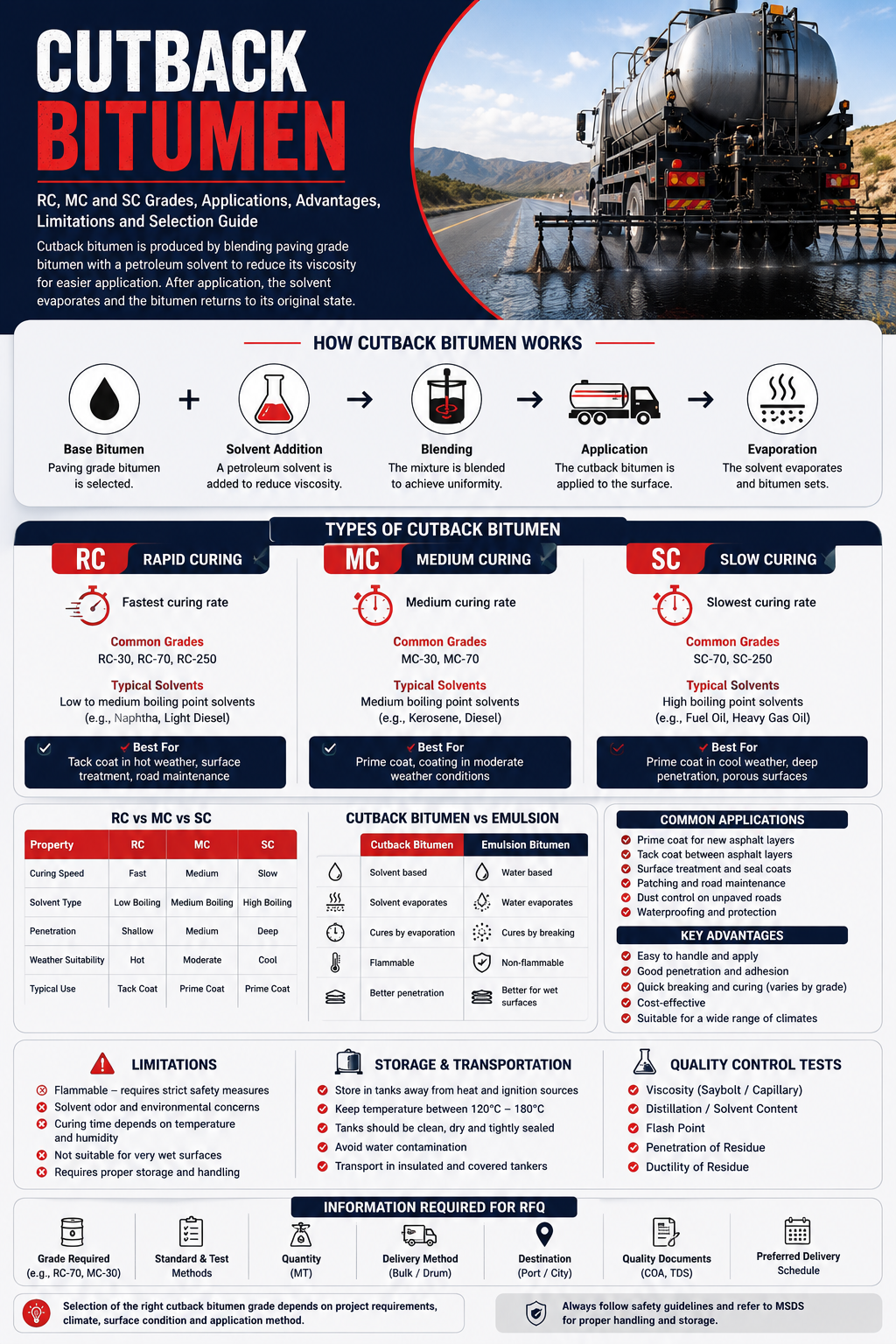
Cutback bitumen guide covering production, RC, MC and SC curing families, common grades, applications, quality-control tests, selection factors and key storage and safety considerations. Click the image to view the full-size version.
RC, MC and SC Cutback Bitumen
Rapid Curing (RC)
RC products use a relatively fast-evaporating solvent and develop residual-binder properties more quickly. Common examples include RC-70, RC-250, RC-800 and RC-3000.
Medium Curing (MC)
MC grades use an intermediate-volatility distillate. Common examples include MC-30, MC-70, MC-250, MC-800 and MC-3000.
Slow Curing (SC)
SC products contain a less volatile oily diluent and provide a longer working period. Common examples include SC-70, SC-250, SC-800 and SC-3000.
| Family |
Relative curing rate |
Common examples |
General application tendency |
| RC |
Rapid |
RC-70, RC-250, RC-800, RC-3000 |
Selected spray work and surface treatments |
| MC |
Medium |
MC-30, MC-70, MC-250, MC-800, MC-3000 |
Prime coats, patching and selected cold mixtures |
| SC |
Slow |
SC-70, SC-250, SC-800, SC-3000 |
Selected road-mixing, cold-mix and dust-control work |
Important: The number following RC, MC or SC identifies a viscosity class within that family. It does not represent solvent percentage, curing time or direct application temperature.
Cutback Bitumen vs Bitumen Emulsion
Cutback bitumen and bitumen emulsion both reduce handling viscosity, but they use different carrier phases. Cutback uses a petroleum solvent, while emulsion disperses bitumen droplets in water with an emulsifying agent.
| Criterion |
Cutback bitumen |
Bitumen emulsion |
| Carrier phase |
Petroleum solvent or distillate |
Water and emulsifier |
| Curing mechanism |
Solvent evaporation |
Breaking, water release and coalescence |
| Key concerns |
Flammability, vapour exposure and VOC emissions |
Breaking behaviour, charge compatibility and freezing |
| Direct substitution |
Not recommended without redesign and project approval |
For a detailed review, read What Is Bitumen Emulsion?
Cutback Bitumen vs Penetration Grade
Penetration-grade bitumen is a conventional paving binder classified by penetration. Cutback bitumen contains a temporary solvent phase and is classified by curing family and viscosity class. The names are not directly interchangeable.
For a common penetration grade, read What Is Bitumen 60/70?
Common Applications
- Prime coats on selected granular bases.
- Selected surface treatments and spray work.
- Cold mixtures, stockpile mixtures and patching materials.
- Road-mixing and maintenance operations.
- Dust-control applications where permitted.
Potential Advantages
- Lower application viscosity than conventional hot paving bitumen.
- Possible spraying, mixing or pumping at reduced temperatures.
- Different curing families for different project needs.
- Useful workability for selected prime-coat, maintenance and cold-mix applications.
Limitations and Risks
- Volatile-organic-compound emissions.
- Flammability and vapour-exposure risks.
- Weather-dependent curing.
- Possible delay in traffic opening if curing is incomplete.
- Use may be restricted by local environmental or occupational rules.
- Improper storage may change viscosity, flash point or solvent balance.
Important Quality-Control Tests
- Kinematic viscosity at the specified temperature.
- Flash point using the required method.
- Distillation and volatile-fraction recovery.
- Residual bitumen content.
- Penetration and ductility of the residue where required.
- Water content, solubility or other specified properties.
For test interpretation, read What Are the Main Bitumen Quality Control Tests?
How Should the Correct Grade Be Selected?
- Exact curing family and grade.
- Prime coat, surface treatment, cold mixture or other application.
- Required viscosity during spraying, mixing or pumping.
- Desired curing time and traffic-opening schedule.
- Air temperature, humidity, wind and weather forecast.
- Aggregate type, moisture, absorption and surface condition.
- Equipment and storage capability.
- Environmental, fire and worker-safety requirements.
Faster curing is not automatically better. A product that cures too rapidly may reduce penetration or workability, while a product that cures too slowly may delay strength development and traffic opening.
Storage and Transportation
- Use closed, approved tanks with suitable venting and fire protection.
- Keep away from ignition sources, sparks and uncontrolled hot work.
- Do not heat without grade-specific instructions and a documented risk assessment.
- Prevent water entry and contamination with other products.
- Maintain full batch and tanker traceability.
- Follow dangerous-goods classification, labelling and documentation rules.
For general principles, read How Should Bitumen Be Stored and Transported?
Sampling and COA Review
The sample should represent the actual batch, tank, drum or tanker. The container must be compatible, sealed and labelled, and sampling should minimise solvent loss and contamination.
Read How Is Bitumen Sampled? and How to Read a Bitumen Certificate of Analysis.
Factors Affecting Price
- Base bitumen grade and market conditions.
- Solvent type, quality and dosage.
- RC, MC or SC grade and specification limits.
- Order quantity and delivery schedule.
- Packaging, dangerous-goods transport and destination.
- Testing, inspection and documentation requirements.
For general pricing factors, read the Iran Bitumen Price Guide.
Information Required for a Quotation
| Required information |
Description |
| Exact product |
RC, MC or SC family and exact grade, such as MC-30 or RC-250 |
| Reference standard |
Named specification, revision, test methods and limits |
| Application |
Prime coat, surface treatment, cold mix, patching or another approved use |
| Quantity |
Metric tons and delivery schedule |
| Packaging and destination |
Bulk, drums or another approved format; country, port, city or delivery point |
| Documents |
COA, TDS, SDS, inspection report and transport documents |
Conclusion
Cutback bitumen is produced by reducing the viscosity of base bitumen with a petroleum solvent or distillate. RC, MC and SC products differ mainly in curing behaviour, while the number following the family identifies a viscosity class within that system.
The correct product depends on the application, specification, weather, aggregate, equipment, traffic-opening requirement, safety plan and local regulations. Buyers should define the exact grade, standard, quantity, packaging, destination and required documents.
Request Cutback Bitumen Specifications and Price
To request a technical review or quotation, provide the required RC, MC or SC grade, reference standard, application, quantity, packaging, destination, delivery terms and required quality and safety documents.
Contact Dejpa and Submit Your Request
Frequently Asked Questions
What is cutback bitumen?
It is a blend of bitumen and petroleum solvent used to temporarily lower viscosity. The solvent evaporates during curing and leaves residual bitumen.
What is the difference between RC, MC and SC?
RC cures rapidly, MC at an intermediate rate and SC more slowly because of different solvent volatility.
What is MC-30 commonly used for?
It is commonly associated with selected prime-coat applications, subject to the project specification, base condition, weather and local regulations.
Is cutback bitumen the same as bitumen emulsion?
No. Cutback uses petroleum solvent, while emulsion uses water and an emulsifying agent.
Can RC, MC and SC be substituted directly?
No. Their curing behaviour and application characteristics differ, so substitution requires technical approval.
Which tests are important?
Typical tests include viscosity, flash point, distillation, residual-binder content and residue properties.
Related Articles
References
- ASTM D2026/D2026M — Cutback Asphalt (Slow-Curing Type).
- ASTM D2027/D2027M — Cutback Asphalt (Medium-Curing Type).
- ASTM D2028/D2028M — Cutback Asphalt (Rapid-Curing Type).
- ASTM D2170/D2170M — Kinematic Viscosity of Asphalts.
- ASTM D402/D402M — Distillation of Cutback Asphaltic Products.
- ASTM D3143/D3143M — Flash Point of Cutback Asphalt with Tag Open-Cup Apparatus.
- ASTM D5/D5M — Penetration of Bituminous Materials.
- Project specification, SDS and applicable local environmental and transport regulations.